
-
Soybean Diseases
- Asian Rust
- Anthracnose
- Bacterial Blight
- Bacterial Pustule
- Bean Pod Mottle Virus
- Brown Stem Rot
- Cercospora Leaf Blight
- Charcoal Rot
- Downy Mildew
- Frogeye Leaf Spot
- Green Stem Syndrome
- Iron Deficiency Chlorosis
- Phytophthora Root & Stem Rot
- Powdery Mildew
- Rhizoctonia
- Seedling Diseases
- Septoria (Brown Spot)
- SCN (Soybean Cyst Nematode)
- Soybean Mosaic Virus
- Stem Canker
- Sudden Death Syndrome
- Viruses
- White Mold
- Soybean Pests
- Diagnostic Help
- Field Trials
- Soybean Library
| Disease: Asian Rust |

Your Soybean Checkoff.
Delivering Results.
Illinois
Indiana
Iowa
Kansas
Michigan
Minnesota
Missouri
Nebraska
North Dakota
Ohio
South Dakota
Wisconsin
Asian Soybean Rust
 |
| Producers, universities, industry and government have created a practical, applied defense to stop soybean rust from marching across North America... read Working Together Against Soybean Rust» |
Asian soybean rust is a foliar disease caused by the fungus Phakopsora pachyrhizi. It is an aggressive disease capable of causing defoliation and significant yield loss. Asian soybean rust is found in most soybean growing areas of the world. It was found for the first time in North America in November 2004.
Key points to know about Asian soybean rust
- Soybean rust will not survive over the winter in the North Central region because it can't live and reproduce without green living tissue.
- To cause outbreaks in the north, the fungus has to spread north via southern winds during the spring and summer each year.
- Overwintering sites of soybean rust are restricted to areas with very mild winters, such as the gulf coasts of Florida, the very southernmost areas of Texas, or in Mexico.
- Weather conditions in the North Central region will not always be moist enough for rust development, even when spores are present.
-
The most susceptible crop stages are between early flower stage (R1) and mid-seed development stages (R5).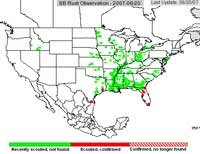
The USDA PIPE soybean rust website, sponsored by the United Soybean Board and the North Central Soybean Research Program, is the most reliable source of ongoing information on soybean rust. Check the rust maps frequently. Click on your state to read current advisories. - Resistant soybean varieties are not yet available. However, resistance genes have been identified and host resistance is expected to be an effective, long-term solution for soybean rust.
- Until resistant commercial varieties are in place, the management of rust depends on judicious use of fungicides.
- A national system of real-time soybean rust monitoring and forecasting has been in place since February 2005 to help growers with spray decisions. This information is posted at the USDA Pest Information for Extension and Education (ipmPIPE) website. Click on your state for local advisories.
Spread of soybean rust and the disease cycle
Spores of the soybean rust pathogen are transported readily by air currents and can be carried hundreds of miles in a few days. Weather conditions will determine when and where the spores travel from south to north.
 |
| Urediniospores of the soybean rust fungus are transported long distances by air currents. |
Rust spores, called urediniospores, are able to penetrate the plant cells directly, rather than through natural openings or through wounds in the leaf tissue. Thus infection is relatively quick: about 9 to 10 days from initial infection to the next cycle of spore production.
Rust is a multi-cyclic disease. After the initial infection is established, the infection site can produce spores for 10 to 14 days. Abundant spore production occurs during wet leaf periods (in the form of rain or dew) of at least 8 hours and moderate temperatures of 60 to 80° F.
Soybean rust has a wide host range
Phakopsora pachyrhizi has a wide host range, which is unusual for a rust pathogen. A “host” is a plant on which the rust fungus can survive. At least 89 different plants can host the fungus. The common weed kudzu is the host of greatest concern because it is so widespread in the southern U.S. The full impact of soybean rust will probably first be known when the kudzu acreage is fully infected with Phakopsora pachyrhizi. Other common hosts are yellow sweet clover, vetch, lupine, green and kidney bean, lima bean, and butter bean.
The name Asian soybean rust is used to distinguish the soybean rust disease caused by Phakopsora pachyrhizi from a mild form of soybean rust, Phakopsora meibomiae , which is endemic to the Caribbean region.